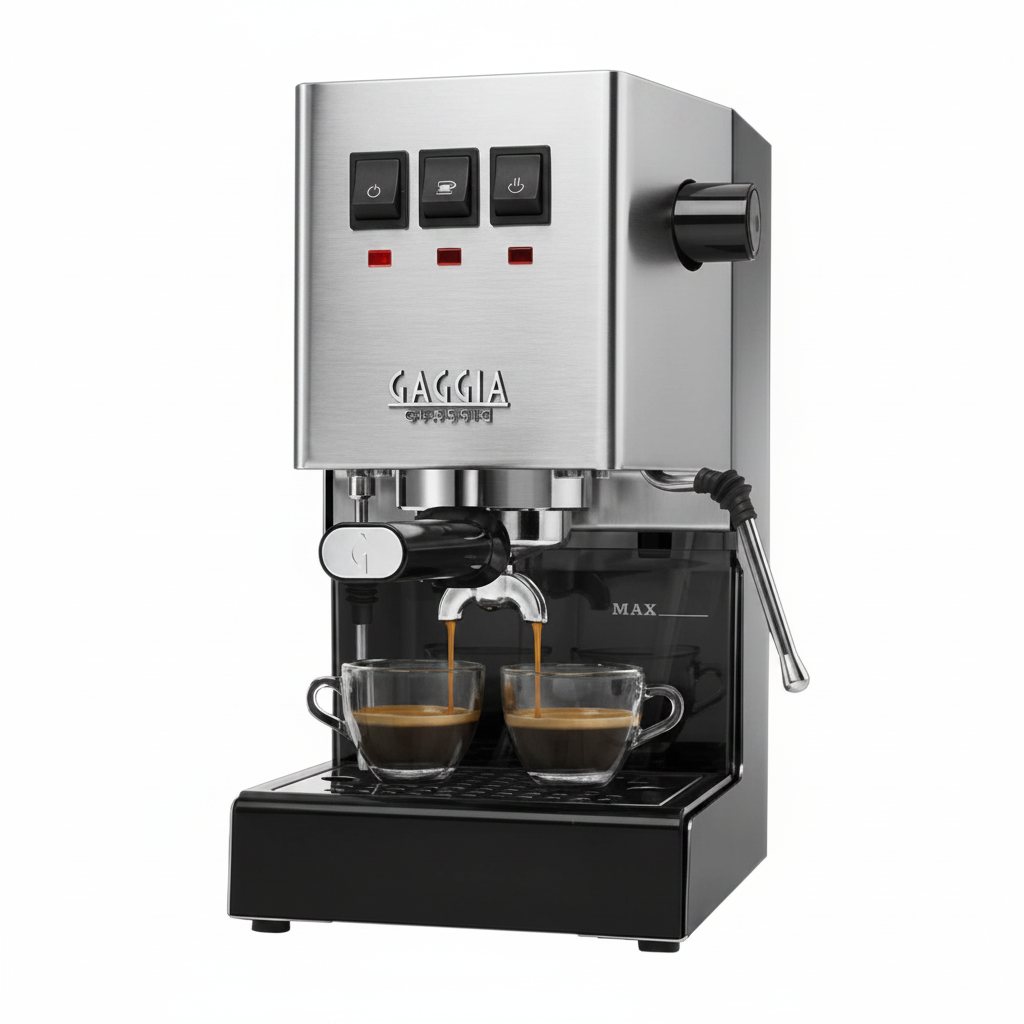
Gaggia Classic Pro Review: The Modder's Espresso Machine That Punches Above Its Weight
If you've spent any time researching espresso machines under AUD $1,000 in Australia, the Gaggia Classic Pro keeps surfacing — and for good reason. But most reviews miss what actually makes this machine compelling for Australian buyers: the mod ecosystem. A $15 OPV spring swap and a $100–200 PID kit can transform the Classic Pro from a capable beginner machine into something that rivals setups costing twice as much. That upgradability, paired with commercial-grade components at a home-friendly price, is why the Gaggia Classic Pro remains one of the most recommended espresso machines for enthusiasts who want to grow with their gear.
We've pulled together AU-specific pricing, local stockist options, grinder pairings at multiple budget tiers, and an honest comparison against the Rancilio Silvia and Breville Bambino — the context Australian home baristas actually need before committing.
Who it's for
The Gaggia Classic Pro is built for the enthusiast home barista who wants to understand espresso, not just press a button. If you enjoy dialling in your grind, experimenting with dose and yield, and the idea of installing a PID controller on a Saturday morning sounds like fun rather than a chore — this is your machine.
That said, motivated beginners shouldn't be scared off. The Classic Pro is one of the most forgiving manual machines to learn on, thanks to its commercial 58mm portafilter (which means abundant basket options and technique guides translate directly) and a massive online community ready to help. Expect a learning curve — you'll need to dial in your espresso and budget 15–20 minutes of warm-up time — but the payoff is café-quality shots at home once you've got the basics down.
Important note: The Classic Pro requires a separate grinder. Budget an additional AUD $150–600 depending on your commitment level (see grinder pairing recommendations below).
Specs at a glance
| Spec | Detail |
|---|---|
| Dimensions | 230mm × 240mm × 380mm (W × D × H) |
| Weight | 8.6 kg |
| Boiler | Lead-free brass, single boiler / dual use |
| Boiler capacity | 100 mL (3.4 oz) |
| Pump | 15 bar Ulka vibratory (OPV set to 9 bar) |
| Water tank | 2.1 L |
| Portafilter | 58mm commercial (stainless steel) |
| Voltage | 220–240V (AU model) |
| Wattage | 1,425W |
| Solenoid valve | 3-way solenoid |
What we like
Commercial 58mm portafilter — The same size used in café machines, which means you can drop in precision VST or IMS baskets for better extraction consistency. This is a feature you rarely see at this price point (coffeebrewshub.com).
Lead-free brass boiler with 3-way solenoid valve — The brass boiler offers excellent thermal mass, and the solenoid valve relieves pressure from the puck after each shot, making cleanup easier and improving shot consistency. These are features typically found on machines at double the price (coffeeness.de).
Unmatched mod ecosystem — This is where the Classic Pro truly separates itself. The community has documented every upgrade path imaginable: OPV spring kits (~AUD $15) to fine-tune brew pressure, PID controllers (~AUD $100–200) for precise temperature control, bottomless portafilters for shot diagnostics, and even flow control kits for profiling. No other machine in this price range offers this depth of upgradability (homegrounds.co).
Commercial-style steam wand — The panarello wand has been replaced (in the Pro revision) with a proper commercial steam wand capable of producing genuine microfoam for latte art. It takes practice, but the results are there (coffeebrewshub.com).
Built like a tank — At 8.6 kg with a stainless steel and metal construction, the Classic Pro feels substantial. It's a machine that can realistically last 10–15 years with basic maintenance.
Where it falls short
Small boiler limits back-to-back drinks — The 100 mL boiler heats fast but only holds enough for roughly two shots before needing temperature recovery time. If you're making drinks for a household of four every morning, expect some waiting (coffeeness.de).
Temperature stability without a PID — The stock thermostat allows temperature drift of several degrees, which affects shot consistency. The community consensus is that a PID mod is close to essential for serious use — budget AUD $100–200 for this upgrade.
Steep learning curve — There's no grind size guidance, no pressure gauge, and no automatic dosing. You'll need to learn temperature surfing (or install a PID), dial in your grinder, and develop a consistent tamping technique. This is part of the appeal for enthusiasts, but beginners should expect a few weeks of mediocre shots before things click.
No built-in grinder — Unlike all-in-one machines such as the Breville Barista Express, the Classic Pro ships without a grinder. A quality espresso grinder is non-negotiable and adds AUD $150–600 to your total outlay (coffeeness.de).
15–20 minute warm-up — The brass boiler needs time to reach thermal equilibrium. Plan your morning routine accordingly.
Grinder pairing recommendations
Since the Classic Pro doesn't include a grinder, here are our suggestions at two budget tiers for Australian buyers:
Beginner tier (AUD $150–250): The 1Zpresso JX-Pro (hand grinder) offers exceptional grind quality for espresso at this price. For electric, look at the Breville Smart Grinder Pro — widely available from AU retailers and a solid starting point.
Enthusiast tier (AUD $400–700): The Eureka Mignon Specialita or Baratza Sette 270 are the go-to choices. Both are stocked by Australian specialty retailers like Alternative Brewing and Coffee Parts, and both produce the grind consistency the Classic Pro deserves.
Classic Pro vs Evo Pro vs E24: Which variant?
Australian retailers stock several Gaggia Classic variants, which can cause confusion:
- Classic Pro (RI9380) — The most common and widely reviewed model. This is the one we're reviewing.
- Classic Evo Pro — Updated internals with a slightly different OPV setting and revised steam knob. Functionally very similar; most mods are cross-compatible.
- Classic E24 — Listed by some AU retailers (notably Alternative Brewing). Appears to be a regional variant with minor cosmetic differences.
For most AU buyers, the differences are minimal. Check which model your preferred stockist carries and confirm mod compatibility before purchasing if you plan to upgrade.
How it compares
Gaggia Classic Pro vs Rancilio Silvia (~AUD $995): The Silvia is the Classic Pro's most direct competitor. It offers a larger boiler (300 mL vs 100 mL), better stock temperature stability, and arguably superior build quality. But it costs roughly AUD $200–250 more, and its mod ecosystem is smaller. If you plan to add a PID anyway, the Classic Pro + PID gets you to near-Silvia performance for less total spend. The Silvia wins if you want better out-of-the-box performance and don't plan to mod.
Gaggia Classic Pro vs Breville Bambino (~AUD $500): The Bambino is significantly cheaper, heats up in 3 seconds (vs 15–20 minutes), and has automatic milk texturing. But it uses a 54mm portafilter, has a less durable build, and offers virtually zero upgrade path. The Bambino is better for convenience-focused beginners; the Classic Pro is better for anyone who wants to develop real barista skills and grow with their machine. See also the DeLonghi Dedica EC685 as another budget alternative.
Verdict
The Gaggia Classic Pro earns its reputation as the best espresso machine under AUD $1,000 for Australian enthusiasts — but only if you go in with realistic expectations. Out of the box, it's a capable but imperfect machine that requires patience, a separate grinder, and a willingness to learn. Where it truly excels is as a platform: add a PID and an OPV spring, pair it with a decent grinder, and you have a setup that produces genuinely excellent espresso for years to come.
For enthusiasts and committed beginners in Australia, we recommend the Gaggia Classic Pro. Budget AUD $900–1,200 all-in (machine + grinder + a mod or two) and you'll have a setup that punches well above typical home espresso machines in this range.
Rating
4.2 / 5 — Outstanding value and upgrade potential, held back slightly by stock temperature instability and the need for essential mods to reach its full capability.
Where to buy
| Stockist | Price (AUD) | Link |
|---|---|---|
| Amazon AU | ~$747 | Buy on Amazon AU |
| Coffee Parts | ~$840–999 | Buy at Coffee Parts |
| Alternative Brewing | ~$840–999 | Buy at Alternative Brewing |
| Appliances Online | ~$840 | Buy at Appliances Online |
Prices current as of April 2026. AU stockists may list different variants (Classic Pro, Evo Pro, E24) — confirm exact model before purchasing.
Sources
- Gaggia Official — Classic Pro
- Amazon AU — Gaggia Classic RI9380
- Coffeeness — Gaggia Classic Pro Review
- Coffee Brews Hub — Gaggia Classic Pro Review
- Home Grounds — Gaggia Classic Pro Review
- Coffee Parts AU — Gaggia New Classic
- Alternative Brewing — Gaggia Classic E24
- Appliances Online — Gaggia New Classic